Fence Styles
What Post and Rail Fencing Looks Like in PVC
See what a PVC post and rail fence looks like: the open rail profile, how it differs from a solid panel fence, and where it suits a Gold Coast property.
Written by Gold Coast PVC Fencing · 2 September 2026
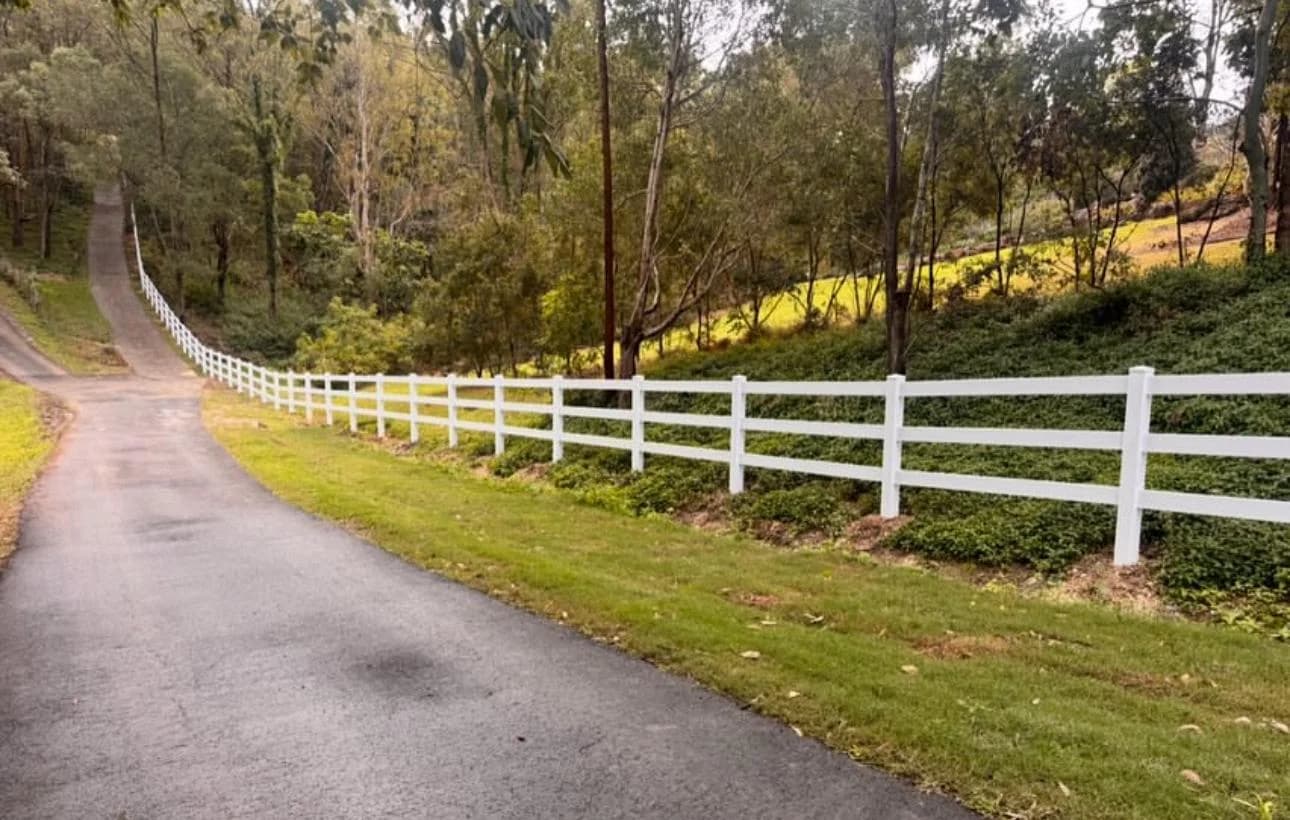
The open-rail profile up close
A post and rail fence is horizontal rails running between upright posts, with gaps between the rails instead of a solid infill panel. In PVC, the look is the same open, linear profile you'd expect from timber post and rail. Evenly spaced posts, two or three horizontal rails per bay, and capped posts, built in white, UV-stabilised PVC instead of timber. It is not a flat panel with a design printed on it. The rails are separate mouldings that slot into the posts, so the gaps are real gaps, not a texture.
Most people picture post and rail in timber because that's what they've seen on rural boundaries and older Gold Coast blocks. The PVC version keeps the same open sightline and the same boundary-marking job, without the maintenance a timber rail fence needs on the coast.
How it differs from a solid PVC panel fence
The difference is entirely about how much you can see through it. A solid panel fence, the style most people picture when they hear "PVC fencing," uses tongue-and-groove vertical boards with no gaps, built for privacy and full screening. Post and rail does the opposite job: it marks a boundary and contains the yard without blocking the view across it.
That makes it a different decision than a privacy or semi-privacy fence, not a lesser version of one. If the goal is screening a pool area or a side boundary from a neighbour, a solid or semi-privacy panel does that job and post and rail doesn't try to. If the goal is a clean, open boundary line (a paddock-style front fence, a driveway edge, a low front-yard line that doesn't block the view from the porch), post and rail is the style built for that.
Does post and rail fencing give privacy? No, and it isn't meant to. The gaps between rails are the point of the style, not a compromise. A buyer who wants both an open look and some screening usually ends up comparing it against a semi-privacy slatted panel instead, which narrows the gaps without closing them completely.
A quick way to compare the four styles by how open they are:
| Style | Openness | Best for |
|---|---|---|
| Post and rail | Fully open between rails | Open boundaries, driveways, rural-style blocks |
| Semi-privacy (slatted) | Partially open | Some screening wanted without a full wall |
| Solid panel | Fully closed | Pool areas, side boundaries, full privacy |
| Picket | Partially open, vertical | A defined front boundary that still reads as "fenced" |
Where the style suits a Gold Coast property
Post and rail also suits larger blocks where fencing a full boundary in a solid panel would be a much bigger job than the boundary actually needs. It marks the same line with less material and a lighter visual result, which matters on a long run where a solid fence would otherwise dominate the property.
It works best on boundaries where an open sightline is the goal, not an afterthought:
- A front boundary where you want the fence to read as a line, not a wall
- A side or rear boundary bordering open space, a park, or a rural-style block where a solid fence would look out of place
- Anywhere the property already has an open, established sightline you don't want a panel fence to close off
Strength, wind load, and what post and rail won't do
Is PVC post and rail fencing strong? The rails and posts are the same UV-stabilised PVC used across the range. The white is the material itself, not a painted or coated finish, and every Gold Coast PVC Fencing installation carries a 20-year warranty. An open-rail style carries less wind load than a solid panel, which is a practical advantage on an exposed boundary rather than a weakness: less surface area for wind to push against means less strain on the posts over time.
One thing worth knowing before you commit to the style: because it's open, it doesn't contain sightlines the way a solid fence does, so if a pet or a small child's containment is the priority on a particular boundary, that's worth raising at the measure rather than assuming the style will do both jobs.
What is the difference between post and rail and picket fencing? Picket fencing uses closely spaced vertical pickets with a pointed or flat top, a classic front-boundary look with partial visual permeability. Post and rail uses horizontal rails with no vertical infill at all, which opens the sightline much further. They solve different problems: picket suits a defined front boundary that still reads as "fenced," while post and rail suits an open line where the view matters more than the enclosure.
What to bring to the site measure
A post-and-rail quote is straightforward to scope, but a few things speed it up:
A dividing fence on a shared boundary is usually a joint responsibility between neighbours under Queensland law, so it is worth agreeing the exact line and the style with them before the measure. The Queensland Government's own guide to your responsibility as a fence owner is a useful starting point if you haven't had that conversation yet.
- The exact boundary line you want fenced, including where it starts and ends
- Any existing gates, walls, or fencing it needs to connect into
- Whether the line crosses a slope: post and rail can step down a grade, but the installer needs to see it to plan the rail runs
- Photos of the current boundary if you're replacing an existing fence
Booking your post and rail measure
None of that needs to be exact before you call: it's what the site measure is for. Having the boundary line and any connection points in mind just means the measure covers everything in one visit rather than needing a follow-up.
Our installation process page covers what to expect once a quote is accepted, from the initial site visit through to the finished line.
You can request a free quote directly whenever you're ready to book a measure.