Local Guides
Fence Height Regulations in QLD: How High Can a Gold Coast Front Fence Be?
Gold Coast fences up to 2.0 m above natural ground usually need no approval. Corner lots, waterfront blocks, estate rules and pool fencing set other limits.
Written by Gold Coast PVC Fencing · 20 November 2026
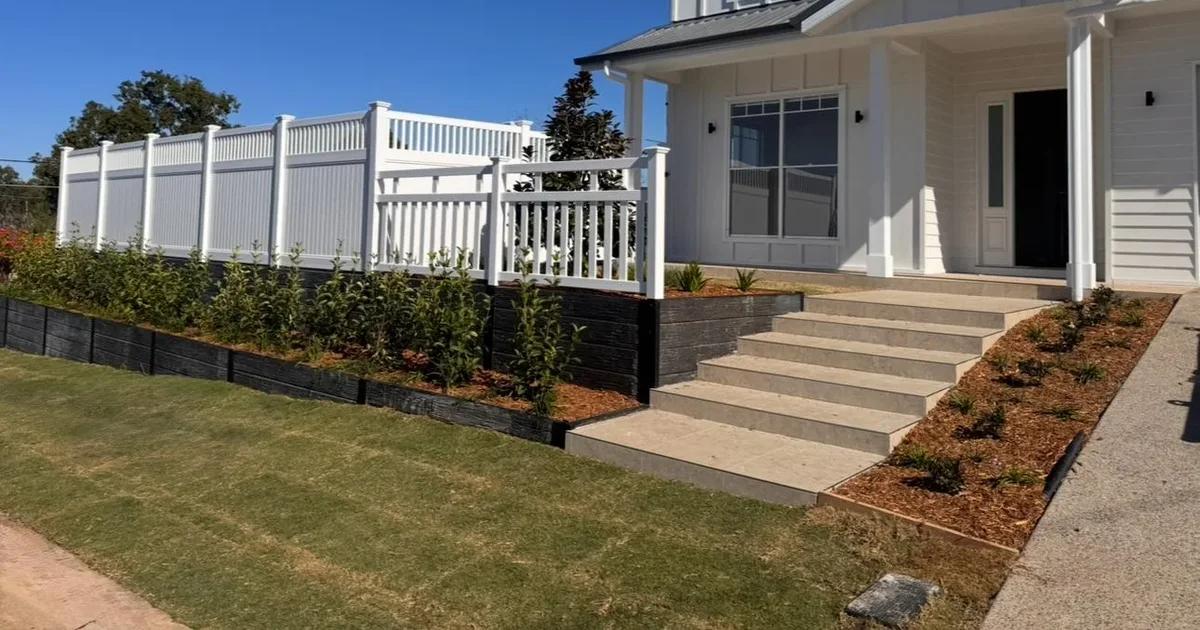
How high can a front fence be on the Gold Coast?
In most cases up to 2.0 m above natural ground, with no building approval. Queensland's fence height rules start with the Building Regulation 2021. Under Schedule 1, a fence needs no approval if it is no higher than 2 m above its natural ground surface and is not a pool fence.
The City of Gold Coast's residential fencing page (checked 20 November 2026) says the same, then lists five exceptions where a lower or separate limit applies:
- corner lots
- swimming pool fencing
- waterfront fencing
- title and contract restrictions, such as estate covenants
- conditions of an earlier development approval
What natural ground means for your fence
The 2.0 m is measured from natural ground, not from a garden bed, a raised path or the top of a wall. The Building Regulation defines natural ground as the ground surface on the day the first survey plan for the lot was registered. On a flat front yard that is usually close to the lawn you stand on. On a built-up block it can sit lower than today's ground, which leaves less height for the fence.
If your front fence sits on top of a retaining wall, a wall over 1 m with a combined height over 2.0 m above natural ground needs a permit. Our guide to building a fence on a retaining wall covers that case.
Corner lots: 1.0 m where the two streets meet
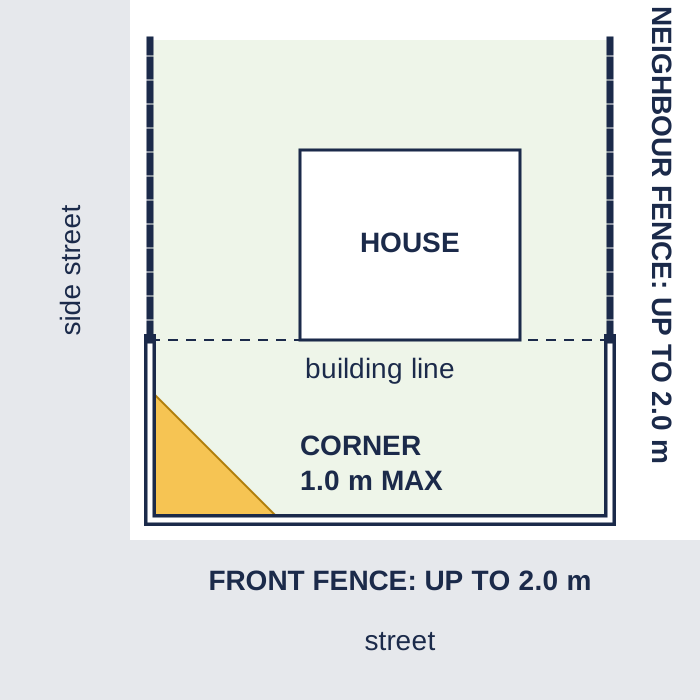
Drivers on both roads need to see around the corner. The City of Gold Coast's residential fencing page says fencing within the corner of a corner lot cannot exceed 1.0 m. The rest of the frontage can still go to 2.0 m.
Whether the limit bites depends on the shape of your boundary. The council's guide for residential fences explains that on a truncated corner, where the boundary is cut across the corner in short lengths, the fence can be taller than 1 m because it does not block the view. On a square corner, where the two boundaries meet in a point, the fence in that spot stays at 1 m or lower.
For the detail of these setback rules, the council points to the Queensland Development Code. The Queensland Government's code page shows those siting rules moving to a new Queensland Housing Code. It commenced on 1 September 2026 and applies in each council area once the local planning scheme adopts it, or from 1 September 2029. The council's setback enquiries team can confirm how far the corner area reaches on your block, and we set out the corner section at the measure.
In practice the corner section steps down to a low run of white pickets or open panels, then climbs back to full height along each street. Done in white PVC, the step reads as part of the design rather than a gap.
Waterfront blocks: 1.2 m and at least half open
Canals and waterways carry floodwater, so the council's standard drawing 04-004 limits waterfront fencing to 1.2 m. The limit applies in the waterfront setback area, measured back from the waterway regulation line. You can see the setback in the City Plan interactive mapping under the coastal hazard supporting layers, and a waterfront search confirms the lines for your block.
The same drawing says waterfront and side fences within the setback area must be at least 50% transparent. That usually rules out solid panels within the waterfront setback area. A fence over 1.2 m in the waterfront setback needs a development permit.
Open styles such as white PVC picket fencing can suit a waterfront. Confirm the setback area with a waterfront search before you choose a panel.
Estate covenants and earlier approvals
Your title or purchase contract may carry covenants that limit the type of front fence. If you bought in a newer estate, check whether its design guidelines set the front fence style.
Earlier development approvals can also set fencing conditions that still apply after the land is subdivided and sold. The council gives one example: a large development was approved on the condition that front fencing was 50% open, and that condition binds later owners too. If the fences along your street all look the same, that may be why.
Check your contract, the estate's design guidelines and any approval conditions before you settle on a height.
Where the front fence turns down the side
The council's fence guide suggests the style and design of the front fence return along the side boundary to meet the main building line of the house. That keeps the look consistent from the street, and the height of that short side run follows the same rules as the rest of the fence.
The fence on the boundary you share with your neighbour, including that short return, is a dividing fence under the Neighbourhood Disputes (Dividing Fences and Trees) Act 2011. Section 13 of that Act says a sufficient dividing fence between two homes is 0.5 m to 1.8 m high. That figure decides what a neighbour can be asked to share, not how high you are allowed to build.
If you are sharing the cost of a new boundary fence, our guide to the Notice to Contribute (Form 2) covers that step.

Setting the height for each run of your fence
Most frontages end up with more than one height. White PVC carries the changes neatly: full privacy or semi-privacy panels for the 2.0 m runs, and picket or post and rail for the 1.0 m and 1.2 m sections, all in the same white. The usual limits and rules by part of the frontage:
- Part of the frontage
- Front fence along the street
- Usual limit or rule
- Up to 2.0 m above natural ground
- Where it comes from
- Building Regulation 2021, Schedule 1
- Part of the frontage
- Corner of a corner lot
- Usual limit or rule
- 1.0 m on a square corner; a truncated corner can be taller
- Where it comes from
- City of Gold Coast fencing page and fence guide
- Part of the frontage
- Within the waterway regulation line
- Usual limit or rule
- 1.2 m, at least 50% open
- Where it comes from
- City of Gold Coast standard drawing 04-004
- Part of the frontage
- Side return to the building line
- Usual limit or rule
- Same style as the front fence; height follows the rules above
- Where it comes from
- City of Gold Coast fence guide, for the style
- Part of the frontage
- Pool fencing
- Usual limit or rule
- Always needs approval and inspection
- Where it comes from
- City of Gold Coast
Planning a front fence with more than one height
Tell us the fence type and length of each run, whether you are on a corner or the water, and where the gates go. We set each section's height at the measure, before we quote.
How high can a front gate be?
As high as the fence beside it. A pedestrian or driveway gate sits in the same run as the fence, so it takes the same limit. A gate inside the corner area of a corner lot is held to the same 1.0 m. Our gate planning guide covers widths, swing and slide before you ask for a quote.
We install matching white PVC gates in the same style as the fence.

What to send for your front fence quote
Call (07) 5638 1221.
Or use our quote form. Either way, include:
- the fence type and the length of each run
- whether the block is on a corner, and a photo of the corner from the street
- whether the block backs onto a canal or waterway
- the number of gates, and whether each is for people or vehicles
- any estate design guidelines or covenant on your title
Common questions
How high can a front fence be in Queensland without approval?
Up to 2 m above the fence's natural ground surface, under Schedule 1 of the Building Regulation 2021, as long as it is not a pool fence. On the Gold Coast, corner lots, waterfront blocks, covenants and earlier approval conditions can set lower limits.
Is 1.8 m the maximum fence height in Queensland?
No. 1.8 m is the top of the range for a sufficient dividing fence between two homes, which decides what neighbours share. A fence can go to 2 m above natural ground without approval, subject to the exceptions.
How high can a fence be on a Gold Coast corner block?
Fencing within the corner where the two streets meet cannot exceed 1.0 m, so drivers can see around it. A truncated corner boundary can take a taller fence. The council's setback enquiries team can confirm how far the corner area reaches on your block. The rest of the frontage can go to 2.0 m.
How high can a waterfront fence be on the Gold Coast?
1.2 m within the waterway regulation line, and fences in the setback area must be at least 50% transparent, under the council's standard drawing 04-004.
Do I need to tell my neighbour before building a front fence?
A front fence on the street boundary sits between you and the road, but the side return runs along your neighbour's boundary, and the council suggests talking to your neighbour and checking your boundaries first. If you want a neighbour to share the cost of a side fence, the Notice to Contribute (Form 2) process applies.
Get your front fence heights right the first time
Tell us the fence type and length, and whether you are on a corner or the water. We measure on site, set each run to the right height and quote the installation.
See more of our Gold Coast work on our Google Business Profile or read what customers say in our Google reviews.